---

Saturday, August 19, 2023

Disposable e-cigarette - Part 4 (Making batteries safe)

 In the fourth part of this series of posts, we'll take a look at making a battery extracted from an e-cig safe to use in your products. 

DANGER: 

There is a really good chance that the battery of a discarded e-cig is still holding quite a lot of energy. The fluid runs out first. So if, during disassembly, the unit triggers (quite likely), then a big current will flow and the heating element will get hot. Similarly any accidental short between the leads to the battery could easily cause a fire.

Cut the leads to the element (one at a time) and to the battery (again one at a time) as soon as you can access them. 

Also have a contingency plan such as fire blanket (not a bucket of water) or open window through which the flaming device can safely be thrown in the event of it catching fire.

If in any doubt that you can do this safely, then don't do it.

The e-cig batteries generally lack the 'protection circuit' found ready soldered across the terminals of the LiPo cell that carry out the following functions:

  • Preventing overcharging (can cause the battery to get hot and catch fire)
  • Preventing over discharging (rendering the battery incapable of holding charge)
  • Over-current protection, safeguarding against short-circuit of battery terminals. (can cause the battery to get hot and catch fire)
Fortunately these protection chips are, well, cheap as chips, because they are used in the billions. You can buy a small panel like this for a few dollars:


Here's the link for the one I bought.
That's right 10 for $1.30!

The idea is that the LiPo cell terminals are soldered to one pair of terminals on the protection PCB and then another pair of terminals are then used to connect to the battery that add the protections.
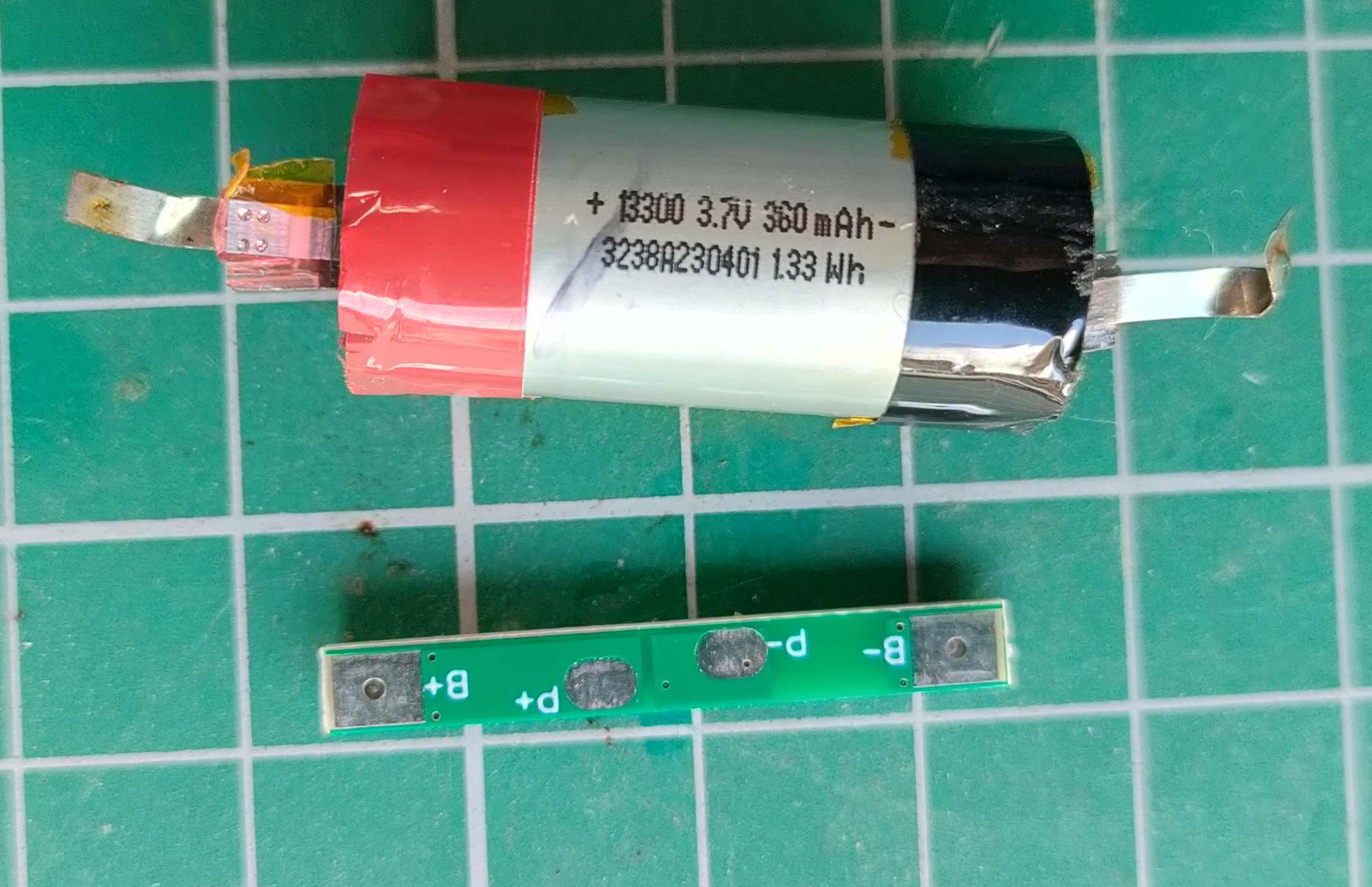

The terminals B+ and B- are for the LiPo cell and P+ and P-. The protection PCB is more likely to stay attached to the cell, if it's soldered close to the terminals, like this:


Notice I have also attached flying leads to protection PCB. It's a good idea not to strip the far ends of these leads until you need to, to prevent accidental short-circuits.

From now on, you should only connect to these leads and not directly to the cell. This will in most cases work exactly the same, except that there is now minimal risk of starting a fire with it.

Note that the protection PCB is not a charging circuit. It makes the LiPo cell safe, but that doesn't mean that you can just connect it to a voltage source and charge it. You will need a LiPo charging circuit to do that properly.

If you have a bench power supply, where you can set both the voltage and the current limit, then a safe way to charge the cell is to:
  1. To be ultra-safe, set the bench power supply's current limit to 1/10 of the cells capacity. For example, for 360mAh like the one shown, set the current limit to 36mA. 
  2. Set the voltage to 4.2V
  3. Connect the battery terminals (the connection PCB terminals - NOT the LiPo cell) and wait until the current drops to 0mA after about 10 hours.
At your own risk, you might like to charge the battery a lot faster - say at 500mA by setting that as the maximum current and still using 4.2V. Because the cells in e-cigs are designed for quite high-current use (several Amps) they should be fine for charging at this sort of current. But keep and eye on it, and stop immediately if the battery starts to get hot.

Monday, August 14, 2023

New Book: Coding: The 21st Century's Most Valuable Skill

MonkMakes Press Publishes Getting Started Guide to the Software Industry

August 10, 2023. Preston, UK.


Press Release

Coding: The 21st Century’s Most Valuable Skill is the latest book by best-selling non-fiction author Simon Monk. 

Aimed squarely at anyone contemplating a career in the software industry, this book gives the reader a taste of coding, as well as a guide to the real-life experiences of working in software. 

[Author Quote] Drawing on my 30 year career in software, as well as interviews with coders from the very biggest and smallest of software companies in the USA and UK, I hope I have shone a light on this industry that is so often hidden from outsiders.

The book is not afraid to pull the reader into the world of coding, with some real world practice. No prior coding experience is required and the reader is led step-by-step through installing the necessary software on  their Mac or PC and taking some first tentative steps.

The paperback and eBook editions are both in full color and are illustrated with comic-strips that make for an amusing and easy read.

If you are interested in a career in software, or just want to learn a bit more about what makes coders tick, then this book will provide you with valuable insights. Released in August 2023, the book is available from Amazon and Barnes and Noble.

Simon Monk, is best known for his books on programming the Raspberry Pi computer and the Arduino. He has sold over 750,000 books in 10 languages. Simon has a doctorate in Software Engineering and worked in the software industry for many years before switching from writing code to writing books. He has published over 20 titles on software and electronics.

Contact (author): simon@monkmakes.com 

Tuesday, August 8, 2023

Disposable e-cigarette Teardown - Part 3

DANGER: 

There is a really good chance that the battery is still holding quite a lot of energy. The fluid runs out first. So if, during disassembly, the unit triggers (quite likely), then a big current will flow and the heating element will get hot. Similarly any accidental short between the leads to the battery could easily cause a fire.

Cut the leads to the element (one at a time) and to the battery (again one at a time) as soon as you can access them. 

Also have a contingency plan such as fire blanket (not a bucket of water) or open window through which the flaming device can safely be thrown in the event of it catching fire.

If in any doubt that you can do this safely, then don't do it.

In the third part of this series of posts, we'll take a look at exactly what's going on in one of the minimal disposable e-cogs -- the type that appears to jus have 3 components: a battery, a heating element and something that looks like an electret microphone.


The 'mic' turns out to be a lot more than just a microphone. For a start it has a blue LED on it that lights for a few seconds when it detects a strong pressure difference. I got this to work by attaching a short length of tubing to it and then blowing into it. 


I attached a load resistor to the output in order to measure the output voltage when the e-cig is activated. No real surprise here, but it matched the battery voltage closely.

Here, you can also see wha happens a the output when the e-cig is activated. Here is the wiring diagram for the e-cig.


The mystery 'mic' is acting as a high-side switch. That is. one side of the heater element is connected to the battery negative (GND) and the 'mic' (when activated) connects the other end of the heater to the positive terminal of the battery.

I think that the 'mic' might actually be a pressure detector plus microcontroller MOSFET and LED all in an electret-insert-style case. The back of the case being a thin PCB with the LED on the outside. The only reason that I think the 'mic' might have a microcontroller in it, is the way that the output is timed and that the LED blinks just before the e-cig deactivates.

Here's my best guess as to what's in the 'mic' can.


The pressure sensor may actually be a microphone, and the microcontroller does some thresholding and to decide if the air rushing over it constitutes someone drawing on the e-cig and then sets the output low to turn the P-channel MOSFET on. The LED does not seem to be in parallel with the output load, as applying a voltage back to the output when the e-cig is not activated does not light the LED. So, it looks like the LED is either connected to a different GPIO pin to the MOSFET, or its on the gate side.

Anyway - my collection of handy LiPos, of various sizes, is gradually increasing. There are just so many of these out there discarded on the street.

Sunday, August 6, 2023

Disposable e-cigarette Teardown - Part 2

I seem to be inadvertently gaining a new hobby. A short cycle ride last week yielded 3 more 'disposable' e-cigs.


DANGER: 

There is a really good chance that the battery is still holding quite a lot of energy. The fluid runs out first. So if, during disassembly, the unit triggers (quite likely), then a big current will flow and the heating element will get hot. Similarly any accidental short between the leads to the battery could easily cause a fire.

Cut the leads to the element (one at a time) and to the battery (again one at a time) as soon as you can access them. 

Also have a contingency plan such as fire blanket (not a bucket of water) or open window through which the flaming device can safely be thrown in the event of it catching fire.

If in any doubt that you can do this safely, then don't do it.

This time, two ENG Legends and a more substantial R and M Tornado. The latter had a USB-C connector and although I couldn't see a way to refill it with fluid, looked like a reusable model. This turned up some interesting clues, as you will see later.

First, the ENG model. This is very similar to the models I took apart in my previous post.


Again, it's much the same arrangement with a thing looking for all the world like an electret mic insert switching the battery to the heating element. It has a nice useable 5.5Wh battery -- again without any protection PCB.

The insides of the R and M Tornado are altogether much more interesting. 


Not only does this board have a little PCB holding a LiPo charging circuit and USB-C socket, but also the PCB is nicely designed and silkscreen labels for the parts and terminals. A second PCB for the heating element has what I assume to be a SOT-23 MOSFET. The heater PCB receives power from the battery and a control signal from the first PCB,

This PCB has the USB socket and LiPo charging on one side.


The other side has a microphone that supplies the control signal to turn the heating element on.


This PCB is a handy little charging circuit. There is no obligation to use the 'puff sensing' feature. With the addition of a switch and a CREE LED bulb, you could make a great little USB torch. Maybe something for the next blog post.