---

Showing posts with label e-cigarette. Show all posts

Saturday, August 19, 2023

Disposable e-cigarette - Part 4 (Making batteries safe)

 In the fourth part of this series of posts, we'll take a look at making a battery extracted from an e-cig safe to use in your products. 

DANGER: 

There is a really good chance that the battery of a discarded e-cig is still holding quite a lot of energy. The fluid runs out first. So if, during disassembly, the unit triggers (quite likely), then a big current will flow and the heating element will get hot. Similarly any accidental short between the leads to the battery could easily cause a fire.

Cut the leads to the element (one at a time) and to the battery (again one at a time) as soon as you can access them. 

Also have a contingency plan such as fire blanket (not a bucket of water) or open window through which the flaming device can safely be thrown in the event of it catching fire.

If in any doubt that you can do this safely, then don't do it.

The e-cig batteries generally lack the 'protection circuit' found ready soldered across the terminals of the LiPo cell that carry out the following functions:

  • Preventing overcharging (can cause the battery to get hot and catch fire)
  • Preventing over discharging (rendering the battery incapable of holding charge)
  • Over-current protection, safeguarding against short-circuit of battery terminals. (can cause the battery to get hot and catch fire)
Fortunately these protection chips are, well, cheap as chips, because they are used in the billions. You can buy a small panel like this for a few dollars:


Here's the link for the one I bought.
That's right 10 for $1.30!

The idea is that the LiPo cell terminals are soldered to one pair of terminals on the protection PCB and then another pair of terminals are then used to connect to the battery that add the protections.
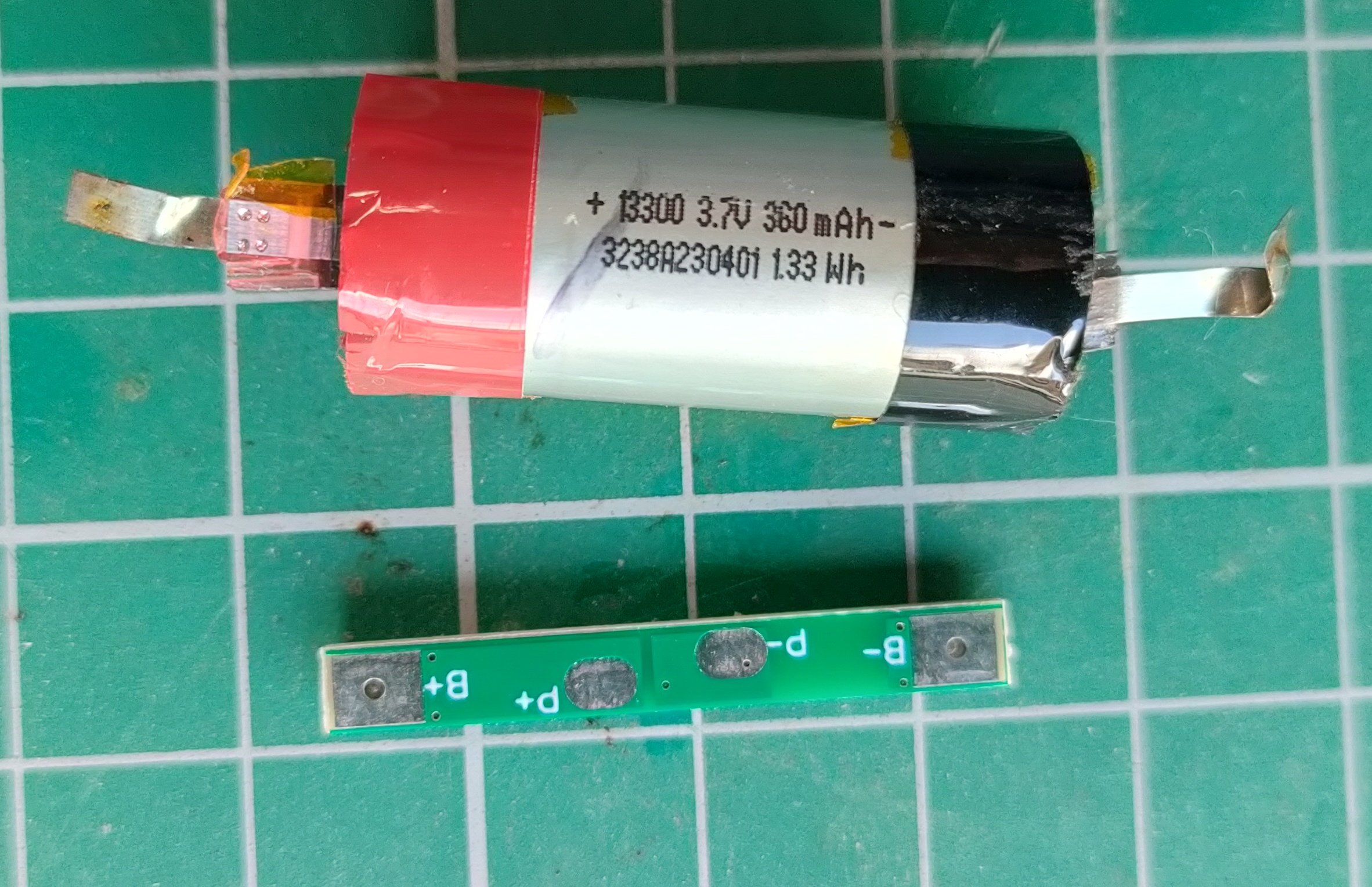

The terminals B+ and B- are for the LiPo cell and P+ and P-. The protection PCB is more likely to stay attached to the cell, if it's soldered close to the terminals, like this:


Notice I have also attached flying leads to protection PCB. It's a good idea not to strip the far ends of these leads until you need to, to prevent accidental short-circuits.

From now on, you should only connect to these leads and not directly to the cell. This will in most cases work exactly the same, except that there is now minimal risk of starting a fire with it.

Note that the protection PCB is not a charging circuit. It makes the LiPo cell safe, but that doesn't mean that you can just connect it to a voltage source and charge it. You will need a LiPo charging circuit to do that properly.

If you have a bench power supply, where you can set both the voltage and the current limit, then a safe way to charge the cell is to:
  1. To be ultra-safe, set the bench power supply's current limit to 1/10 of the cells capacity. For example, for 360mAh like the one shown, set the current limit to 36mA. 
  2. Set the voltage to 4.2V
  3. Connect the battery terminals (the connection PCB terminals - NOT the LiPo cell) and wait until the current drops to 0mA after about 10 hours.
At your own risk, you might like to charge the battery a lot faster - say at 500mA by setting that as the maximum current and still using 4.2V. Because the cells in e-cigs are designed for quite high-current use (several Amps) they should be fine for charging at this sort of current. But keep and eye on it, and stop immediately if the battery starts to get hot.

Tuesday, August 8, 2023

Disposable e-cigarette Teardown - Part 3

DANGER: 

There is a really good chance that the battery is still holding quite a lot of energy. The fluid runs out first. So if, during disassembly, the unit triggers (quite likely), then a big current will flow and the heating element will get hot. Similarly any accidental short between the leads to the battery could easily cause a fire.

Cut the leads to the element (one at a time) and to the battery (again one at a time) as soon as you can access them. 

Also have a contingency plan such as fire blanket (not a bucket of water) or open window through which the flaming device can safely be thrown in the event of it catching fire.

If in any doubt that you can do this safely, then don't do it.

In the third part of this series of posts, we'll take a look at exactly what's going on in one of the minimal disposable e-cogs -- the type that appears to jus have 3 components: a battery, a heating element and something that looks like an electret microphone.


The 'mic' turns out to be a lot more than just a microphone. For a start it has a blue LED on it that lights for a few seconds when it detects a strong pressure difference. I got this to work by attaching a short length of tubing to it and then blowing into it. 


I attached a load resistor to the output in order to measure the output voltage when the e-cig is activated. No real surprise here, but it matched the battery voltage closely.

Here, you can also see wha happens a the output when the e-cig is activated. Here is the wiring diagram for the e-cig.


The mystery 'mic' is acting as a high-side switch. That is. one side of the heater element is connected to the battery negative (GND) and the 'mic' (when activated) connects the other end of the heater to the positive terminal of the battery.

I think that the 'mic' might actually be a pressure detector plus microcontroller MOSFET and LED all in an electret-insert-style case. The back of the case being a thin PCB with the LED on the outside. The only reason that I think the 'mic' might have a microcontroller in it, is the way that the output is timed and that the LED blinks just before the e-cig deactivates.

Here's my best guess as to what's in the 'mic' can.


The pressure sensor may actually be a microphone, and the microcontroller does some thresholding and to decide if the air rushing over it constitutes someone drawing on the e-cig and then sets the output low to turn the P-channel MOSFET on. The LED does not seem to be in parallel with the output load, as applying a voltage back to the output when the e-cig is not activated does not light the LED. So, it looks like the LED is either connected to a different GPIO pin to the MOSFET, or its on the gate side.

Anyway - my collection of handy LiPos, of various sizes, is gradually increasing. There are just so many of these out there discarded on the street.

Wednesday, July 19, 2023

Disposable e-cigarette Teardown - Part 1

I went for a lunch-time walk with the intention to look out for a discarded 'disposable' e-cigarette. I found by the side of the road almost immediately.


DANGER: 

There is a really good chance that the battery is still holding quite a lot of energy. The fluid runs out first. So if, during disassembly, the unit triggers (quite likely), then a big current will flow and the heating element will get hot. Similarly any accidental short between the leads to the battery could easily cause a fire.

Cut the leads to the element (one at a time) and to the battery (again one at a time) as soon as you can access them. 

Also have a contingency plan such as fire blanket (not a bucket of water) or open window through which the flaming device can safely be thrown in the event of it catching fire.

If in any doubt that you can do this safely, then don't do it.

This was quite a big one, and looking on the Internet sells for about £10 ($12). Far from being a flimsy thing, the case was well made and looked like it was designed to be taken apart. One end was held in place by push clips that opened easily with a screwdriver.


So what did I find! Well, a lot less than I was expecting! There are just 3 electronic components:

  • The battery - 5.18Wh cylindrical LiPo. This was still measuring 3.4V
  • The heating element - showing a cold resistance of 1Ω
  • What looked like an electret mic insert, but I believe from the wiring, detects the cigarette being sucked, and switches power from the battery to the coil


There was no sign of any microcontroller or protection chip for the battery. The wiring is 0.4mm including insulation and not something that looked like it would cope with 3-4A. Hot wires and a heating element next to a LiPo cell - what could possibly go wrong!

Anyway, the battery is on charge and I'm pretty sure will come in very handy in some project or other.


I think it's a terrible waste of resources that these things are sold as disposable with insincere promises that they will be recycled properly. They aren't - people just drop them in the street.